

Field guide · rare
Ocelot
Spotted stealth of the Americas — a medium wild cat threading rainforest and scrub by night.
Least Concern
Leopardus pardalis
Overview
Ocelots are medium-sized spotted cats ranging from the southern United States through Central and South America. Nocturnal and solitary, they hunt rodents, birds, and reptiles along forest trails and river edges.
For Mexico, Costa Rica, and Brazil collectors, an ocelot track or night-camera glimpse is a high-value Neotropical cat card.
- Scientific nameLeopardus pardalis
- Length70–100 cm body; tail ~30–45 cm
- Weight8–15 kg
- LifespanAround 7–10 years in the wild
- DietCarnivore
- ConservationLeast Concern
- RegionNeotropical Forest
Where to see them
Habitat
- Tropical forest
- Mangrove
- Thorn scrub
- Gallery woodland
Tropical and subtropical forests, mangroves, thorn scrub, and gallery woodland with dense cover, from Mexico and Central America deep into South America.
Field notes
Field scale for the Ocelot: length around 70-100 cm body; tail ~30-45 cm; weight 8-15 kg. Typical lifespan: Around 7-10 years in the wild.
When you are scanning habitat, prioritise tropical forest, mangrove, thorn scrub, and gallery woodland. Those settings are where a clean look and a usable photo are most likely.
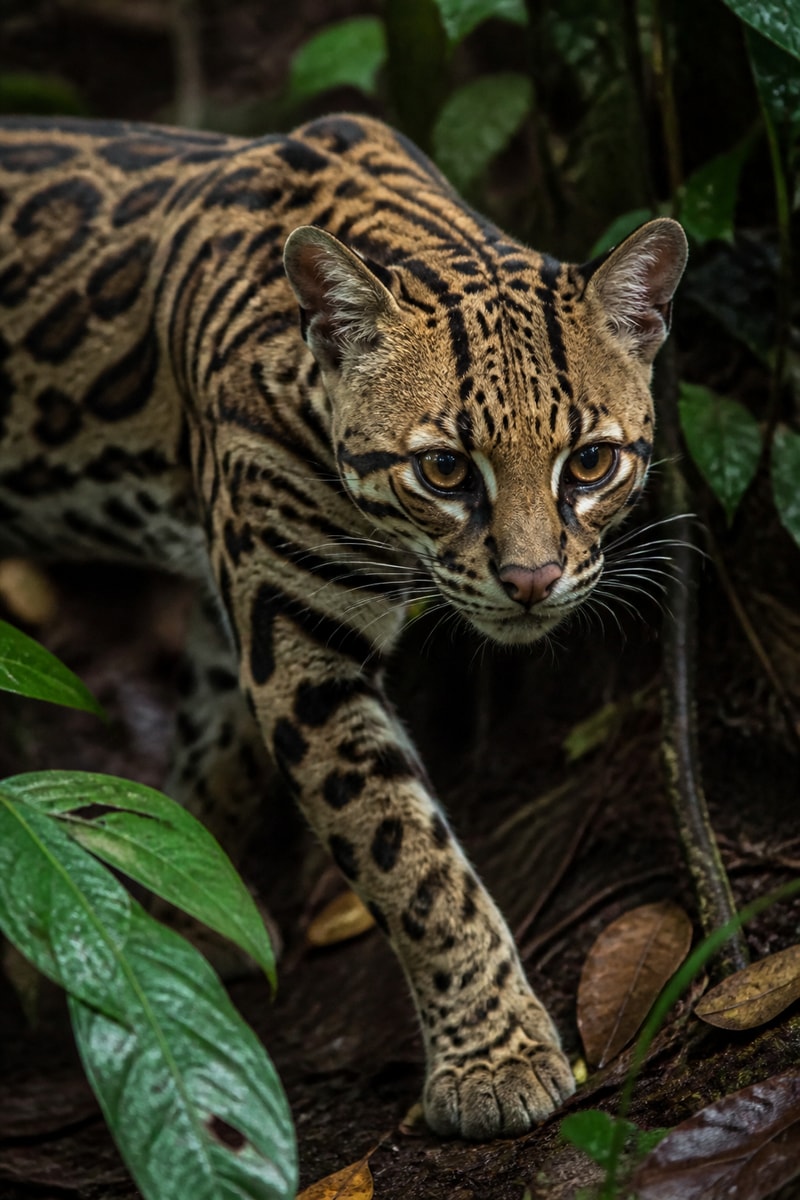
Quick ID anchor: Tawny to greyish coat with solid black spots and elongated rosettes; white underside. Confirm with behaviour and habitat before you log the discovery.
Where to see one
Costa Rica
In Costa Rica, strong options include Monteverde Cloud Forest and Corcovado National Park. Misty canopy bridges and moss-draped trees, with sloths, quetzals, and hummingbirds in cool highland forest.
Open the Costa Rica spotting guide for every park note tied to the ocelot.
Brazil
In Brazil, strong options include Pantanal and Amazon Rainforest. The world's largest tropical wetland, with capybaras, jaguars, hyacinth macaws, and giant otters in open savanna.
Open the Brazil spotting guide for every park note tied to the ocelot.
Diet
Carnivores taking small mammals, birds, reptiles, amphibians, and occasionally fish or crabs.
Ambush and stalk along trails, stream banks, and forest edges.
Behaviour
Solitary and largely nocturnal; communicate with scent marks and soft calls.
Climb trees to rest or hunt; travel long distances within a territory.
How to identify
Tawny to greyish coat with solid black spots and elongated rosettes; white underside.
Rounded head, large eyes, and a relatively short, ringed tail.
Interesting facts
- 01
Coat pattern is unique to each individual, like a fingerprint.
- 02
Mostly nocturnal; rest in dense cover by day.
- 03
Prey includes rodents, rabbits, birds, lizards, and frogs.
- 04
Excellent climbers and swimmers.
- 05
Home ranges are scent-marked and defended against rivals.
- 06
Once heavily hunted for the fur trade.
Conservation status
Ocelots are Least Concern overall but decline where forests are cleared and roadkill is high. Connected habitat from Mexico to Brazil keeps regional populations viable.
Sources: IUCN Red List







Keep exploring
Where it lives
Related discoveries
- Jaguarlegendary • Rainforest & Wetland
- Harpy Eaglelegendary • Rainforest Canopy
- Resplendent Quetzallegendary • Cloud Forest
- Green Anacondalegendary • Wetlands & Rivers
- Golden Lion Tamarinlegendary • Atlantic Forest Canopy
- Baird's Tapirlegendary • Central American Forest
- Arapaimalegendary • Amazon Floodplain
- Axolotlrare • Lake & Canals
Free on iOS
Catch the Ocelot
Spot one in the wild, then scan it in Catch'Um to log your rare discovery.